 Skip to content

Kenya · National Parks & Wildlife
Mount Kenya National Park
Glacier-carved valleys, giant lobelias and a sunrise summit at Point Lenana, on Africa’s second-highest mountain.
Location
Central Kenya
Trekking summit
Point Lenana, 4,985 m
Best time
January to February
Ideal trek
Four to six days
The mountain
Kenya’s great mountain
Mount Kenya is an extinct volcano straddling the equator, about 150 km north of Nairobi. Its highest peaks, Batian and Nelion, need technical climbing, but Point Lenana at 4,985 m is reachable on foot by fit trekkers, with a pre-dawn climb to watch the sun rise over the plains.
The trek passes through distinct zones: bamboo and rainforest on the lower slopes, open moorland of giant groundsels and lobelias, then rock, scree and glacial tarns near the summit. The mountain and its forests are a UNESCO World Heritage Site, and buffalo, elephants and colobus monkeys live on the lower slopes.
After your trek, relax at Samburu to the north or the Lake Nakuru area, or see our Mount Kenya trekking trips.
Places your guide will show you
Sirimon RouteNaro Moru RouteChogoria RoutePoint LenanaLake MichaelsonShipton’s Camp
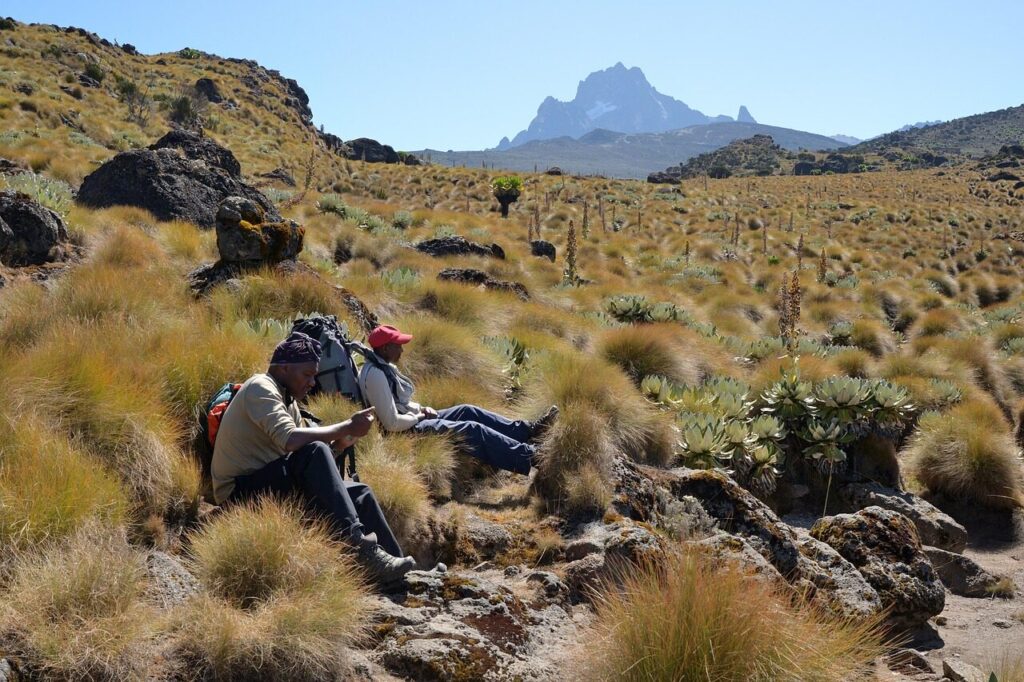

Summit day
Reach Point Lenana for sunrise
On the mountain
Life on the mountain
Each altitude zone has its own plants and animals, from forest elephants to giant alpine plants.
Scroll for more →
01
Colobus monkey
Black-and-white colobus leap through the montane forest.
02
Elephant
Forest elephants live on the lower slopes and are sometimes seen from the tracks.
03
Buffalo
Common in the forest and lower moorland, so guides stay alert.
04
Giant lobelia
Strange alpine plants that grow taller than people in the moorland.
05
Glacial valleys
Deep U-shaped valleys and tarns shaped by ancient glaciers.
On the trail
More than a summit
Every Mount Kenya trek is guided, with porters and cooks, so you can focus on the walk.

Guided treks
Choose Sirimon, Naro Moru or Chogoria, or combine two routes.

Point Lenana summit
An early start for sunrise at 4,985 m on the final morning.

Mountain camping
Sleep in huts or tents, with hot meals prepared by your crew.

Tarns and streams
Pass glacial lakes and mountain streams in the high valleys.

Foothill safaris
Add game drives at Ol Pejeta or Samburu before or after your trek.

Photography
Moorland, peaks and sunrises above the clouds.
When to visit
The best time to trek
The mountain can be trekked most of the year, but the dry seasons give the safest, clearest conditions.
Jan – Feb
Peak season
Main dry season
Clear, stable weather and the best summit views.
Mar – May
Long rains
Wet, misty and slippery. Most treks avoid these months.
Jun – Oct
Long dry season
Good trekking weather, cold nights and clear mornings.
Nov – Dec
Short rains
Afternoon showers and cloud. Trekking is possible with good gear.
Getting there
Reaching the mountain
By road
Three to four hours from Nairobi to the Sirimon, Naro Moru or Chogoria trailheads.
By air
Scheduled flights to Nanyuki take about 45 minutes from Wilson Airport.
Combined routes
Treks pair well with Ol Pejeta, Samburu or a Maasai Mara safari.
Where to stay
Huts, camps and lodges
01
Mountain huts and camps
Basic huts and tented camps along each trekking route.
02
Nanyuki and Naro Moru
Comfortable lodges near the trailheads for the nights before and after.
03
Foothill conservancies
Safari lodges at Ol Pejeta and nearby ranches for post-trek game drives.
Mountain park fees are set by the Kenya Wildlife Service and charged per person per day. Your trek quote will include current rates.
Ready-made trips
Mount Kenya treks and safaris
Guided Mount Kenya climbs on the main routes, plus safaris that pass through the mountain region.
- Ol Pejeta Conservancy, Laikipia
- 1 Day
- Nairobi, Treetops, Samburu, Ol Pejeta, Lake Nakuru, Maasai Mara, Lake Naivasha, Amboseli
- 12 Days 11 Nights
- Mount Kenya, Samburu, Lake Nakuru, Maasai Mara, Lake Naivasha, Amboseli
- 10 Days 9 Nights
- Mount Kenya, Ol Pejeta, Lake Nakuru, Lake Naivasha, Maasai Mara
- 9 Days 8 Nights
- Ol Pejeta Conservancy, Samburu, Lake Nakuru, Maasai Mara
- 7 Days 6 Nights
- Mount Kenya, Naro Moru Route, Chogoria Route, Batian Peak
- 6 Days 5 Nights
- Mount Kenya, Naro Moru Route
- 5 Days 4 Nights
- Mount Kenya, Nanyuki, Sirimon Route, Chogoria Route
- 5 Days 4 Nights
- Mount Kenya, Nanyuki, Sirimon Route
- 5 Days 4 Nights
Good to know
Mount Kenya FAQs
How high is Mount Kenya?
Batian, the highest peak, is 5,199 m. Most trekkers summit Point Lenana at 4,985 m, which needs no technical climbing.
How hard is the Mount Kenya trek?
It is challenging but suitable for fit hikers. Altitude is the main difficulty, so routes allow time to acclimatise.
Which route is best?
Sirimon is gentler with good acclimatisation, Naro Moru is the quickest, and Chogoria is the most scenic. Many treks go up Sirimon and down Chogoria.
How many days do you need?
Four to six days, depending on the route. Longer treks improve acclimatisation and summit success.
When is the best time to climb?
January to February and late June to October, the driest months.
Do I need a guide?
Yes. All treks use licensed guides, and porters and cooks carry equipment and prepare meals.
Talk to a planner
Still deciding?
Our Nairobi team can answer anything about Mount Kenya and shape a route around your dates.
- +254 111 318 596
- +254 705 223 484
- info@topmatoursandsafaris.com
- Mon – Sat: 8:00 AM – 6:00 PM
Your journey
Plan your Mount Kenya climb
Tell us your dates, group size and budget, and we will shape a Mount Kenya itinerary around the season and the experiences you want.
